
Good Afternoon,
I am about ready to embark on ‘the next phase’ of measures to combat damp in my Georgian cottage.
Bought in 2012….I knew there were issues with damp ( from the survey) but chose to ignore, as I love old properties & fell in love with this one.
It’s semi- detached & most of the external walls are cold & damp….except for the living room, where I spend most of my time & have a log burner used daily, except at the height of summer.
We have UPVC doors & windows. So far the measures taken have been to combat condensation ( ie installing extractor fans in kitchen/shower room, a PIV system at the top of the stairs & using dehumidifiers when forced to dry washing indoors. I always wipe condensation off windows & open all windows religiously for at least 1 hour daily)
I can only afford to make improvements gradually….in bite size pieces.
I’m now ready to tackle the main source of damp which I believe is the gable end of the house, which abuts a private farm track….the level of which is higher than the internal ground level! I know this is quite a problem but can only tackle one job at a time!
I had a fireplace opened up in the gable end in 2012. When the chimney was opened up a quantity of sooty water gushed out & continued to seep out for some time afterwards. The log burner in that fireplace is not used very frequently, it can be difficult to light and has gone rusty!
Logically I’ve decided that the 1st step is to get the chimney stack repaired. There are cracks in the render & tiles ( in summer vegetation grows up there! )
( see attached photos)
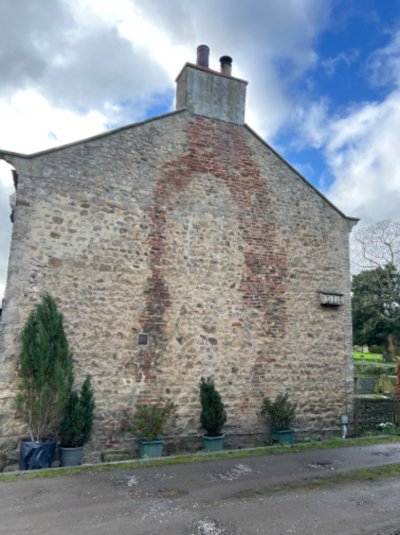
Neither my husband or I are young or fit enough to climb up there ourselves. I have at last found a local builder who will take a look.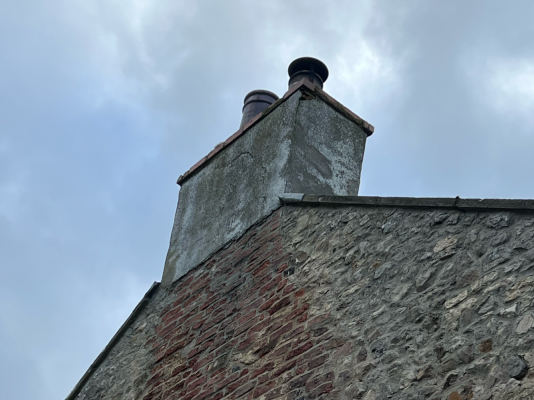
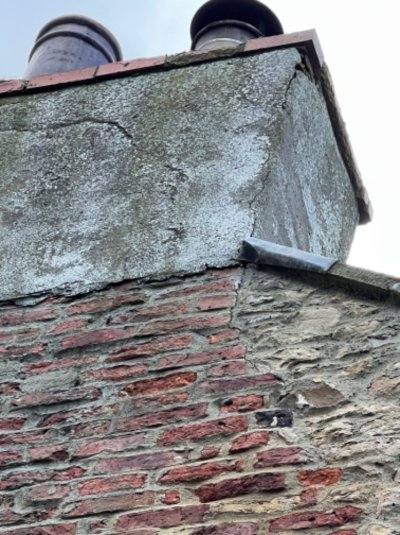
My 1st question…..do I ask the builder to repair the chimney with traditional lime based materials or is this unnecessary or even counterproductive for a chimney stack??
I’m sorry if this seems a very basic question, but would appreciate your thoughts/advice about this.
Thanks, Bethan
I am about ready to embark on ‘the next phase’ of measures to combat damp in my Georgian cottage.
Bought in 2012….I knew there were issues with damp ( from the survey) but chose to ignore, as I love old properties & fell in love with this one.
It’s semi- detached & most of the external walls are cold & damp….except for the living room, where I spend most of my time & have a log burner used daily, except at the height of summer.
We have UPVC doors & windows. So far the measures taken have been to combat condensation ( ie installing extractor fans in kitchen/shower room, a PIV system at the top of the stairs & using dehumidifiers when forced to dry washing indoors. I always wipe condensation off windows & open all windows religiously for at least 1 hour daily)
I can only afford to make improvements gradually….in bite size pieces.
I’m now ready to tackle the main source of damp which I believe is the gable end of the house, which abuts a private farm track….the level of which is higher than the internal ground level! I know this is quite a problem but can only tackle one job at a time!
I had a fireplace opened up in the gable end in 2012. When the chimney was opened up a quantity of sooty water gushed out & continued to seep out for some time afterwards. The log burner in that fireplace is not used very frequently, it can be difficult to light and has gone rusty!
Logically I’ve decided that the 1st step is to get the chimney stack repaired. There are cracks in the render & tiles ( in summer vegetation grows up there! )
( see attached photos)
Neither my husband or I are young or fit enough to climb up there ourselves. I have at last found a local builder who will take a look.
My 1st question…..do I ask the builder to repair the chimney with traditional lime based materials or is this unnecessary or even counterproductive for a chimney stack??
I’m sorry if this seems a very basic question, but would appreciate your thoughts/advice about this.
Thanks, Bethan
Last edited: