
Hello,
I'd really appreciate some advice on damp corners in our 1870s Victorian terrace. In the process of renovating we have stripped off the painted lining paper in our living room/dining room to find some past attempts to control damp. In all three external facing corners the lime plaster has been removed up to about 1m and filled instead with a sand and cement render. The whole lot has then been painted with bitumen. Outside we have a sand and cement render that goes right down to the paving slabs (as it does on all the other houses on our street) but the air bricks for our cellar are all clear and we have good ventilation down there. The humidity in the cellar is not high but the ground floor joists that rest on the brick walls down there are slightly damp (something to keep an eye on).
We have had the damp looked at by a specialist and he confirmed that the house has no DPC so there is damp coming up through the cellar walls where it meets a horrible moisture trap caused by wallpaper, the sand and cement and the bitumen. We can try and undo this by having the internal plaster redone in lime but I am wondering what prompted the damp proofing in the first place if the house was originally plastered and rendered in breathable materials. There must have been a reason to hack it all out and replace it with sand and cement. If you have a house that was built without a DPC, is it always going to be a bit damp even with lime given that we have better insulation etc than in the past? Is replastering in lime the right approach? The surveyor mentioned a water based DPC that you can have injected which is better than a chemical one but everything i've read suggests any kind of injected DPC is a bad idea.
My second question is, I highly doubt that we can afford to have the whole living room/dining room done in lime plaster. Can we just do the external facing walls and skim the internal, party wall and chimney stacks in gypsum? These walls are not damp at all but I am slightly worried that we'll create damp by skimming in gypsum.
Third question, is it likely that we'll have to remove the sand and cement render on the outside too? Is lime the way to go there as well? Is there anything else we could do outside to improve things?
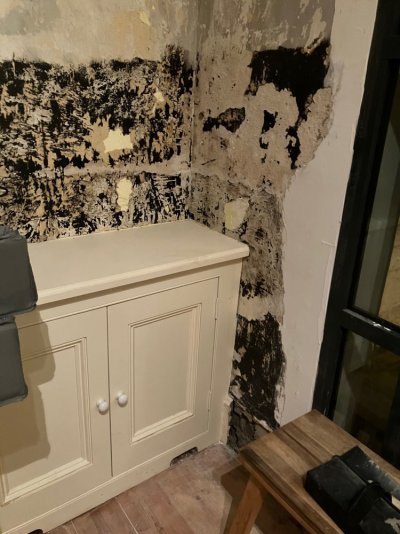
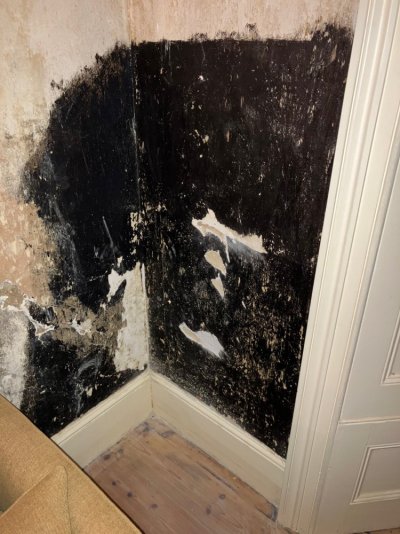
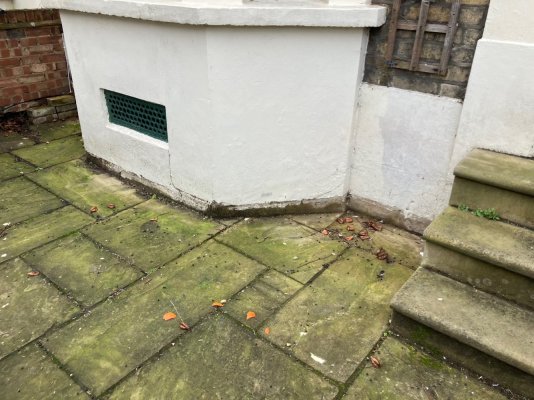
These photos show the two worst damp patches inside with the bitumen paint. The horizontal lines mark the place where the sand and cement has been used below. The front bay rendering is in decent condition apart from the area at the bottom where it appears to have been repaired in places. The weird discolored area next to the steps could be bitumen paint under the white paint. We can clearly see it next to the front door so we know it was painted on some areas outside.
Thanks in advance for any thoughts!
I'd really appreciate some advice on damp corners in our 1870s Victorian terrace. In the process of renovating we have stripped off the painted lining paper in our living room/dining room to find some past attempts to control damp. In all three external facing corners the lime plaster has been removed up to about 1m and filled instead with a sand and cement render. The whole lot has then been painted with bitumen. Outside we have a sand and cement render that goes right down to the paving slabs (as it does on all the other houses on our street) but the air bricks for our cellar are all clear and we have good ventilation down there. The humidity in the cellar is not high but the ground floor joists that rest on the brick walls down there are slightly damp (something to keep an eye on).
We have had the damp looked at by a specialist and he confirmed that the house has no DPC so there is damp coming up through the cellar walls where it meets a horrible moisture trap caused by wallpaper, the sand and cement and the bitumen. We can try and undo this by having the internal plaster redone in lime but I am wondering what prompted the damp proofing in the first place if the house was originally plastered and rendered in breathable materials. There must have been a reason to hack it all out and replace it with sand and cement. If you have a house that was built without a DPC, is it always going to be a bit damp even with lime given that we have better insulation etc than in the past? Is replastering in lime the right approach? The surveyor mentioned a water based DPC that you can have injected which is better than a chemical one but everything i've read suggests any kind of injected DPC is a bad idea.
My second question is, I highly doubt that we can afford to have the whole living room/dining room done in lime plaster. Can we just do the external facing walls and skim the internal, party wall and chimney stacks in gypsum? These walls are not damp at all but I am slightly worried that we'll create damp by skimming in gypsum.
Third question, is it likely that we'll have to remove the sand and cement render on the outside too? Is lime the way to go there as well? Is there anything else we could do outside to improve things?
These photos show the two worst damp patches inside with the bitumen paint. The horizontal lines mark the place where the sand and cement has been used below. The front bay rendering is in decent condition apart from the area at the bottom where it appears to have been repaired in places. The weird discolored area next to the steps could be bitumen paint under the white paint. We can clearly see it next to the front door so we know it was painted on some areas outside.
Thanks in advance for any thoughts!