fernicarry
Member
- Messages
- 829
- Location
- Argyllshire
"No rest" as they say. I'm straight into my next project, refitting the front box room as a shower room. I say next, but actually, like many projects around here, I started it several years ago and then it got shelved for "reasons".
This room was a Jack and Jill shower room when we moved in accessed from the original door in the hallway and a new doorway that had been unsympathetically knocked through from the main bedroom. At 9'x8' its quite a generous size which doesn't really explain why it used to house the world's smallest shower cubicle containing the world's weakest electric shower. Luxury it was not and it was the only shower for the whole house at the time. That's all been swept away and the room stripped to bare walls and rafters.
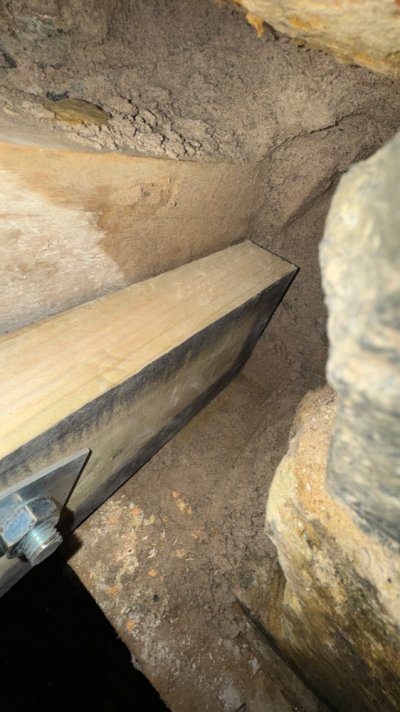
Which is when problems came to light. Several of the joist ends were barely hanging on and with the ceiling stripped you could see the backs of the sarking boards just above the wall head were soaking. I thought this must be due to a badly detailed overflow pipe for the old cistern in the loft but with that deleted and slated over it was still wet. Then I happened to spot a flash of light between the sarking boards coming from below the valley gutter. Closer examination revealed a pin hole in the valley that was allowing water to soak in. I believe that over time this took out the joist ends and also the front door lintel below. All completely hidden from view, possibly going on for decades. That's all been fixed (almost, see later).
The plan for the room is to split it into two and have an ensuite accessed only from the bedroom and another room accessed from the hall. This second room could potentially be fitted out as another shower room but we'll probably use it for storage. Both rooms will be pretty tight but I'll still be able to fit in a bigger shower than before.
I'm going to be practicing what I preach trying to stay true to the breathable mantra as far as possible as I build it back up. It'll be basically the same IWI system as I used in the downstairs room -- a parge/dub coat of insulating plaster, studwork holding flexible hemp batts, wood wool boards and lime plaster. The shower area will be cement board though. There will be UFH and I've already cut away the floor boards (none in decent shape) and put wood fibre insulation between the floor joists. Last time around I had started on the parge coat.
Here's where I picked up. The new partition will go side to side so the front half gets the rooflight and the rear half won't have any natural light. This will somewhat reduce the amount of light reaching the top landing if all the bedroom doors are closed. I did consider splitting front to back so that both rooms could have light but that would have meant rejigging the roof to fit two rooflights and getting the soil pipe to both halves would have been problematic. Too big a job, see, sometimes I'm sensible...
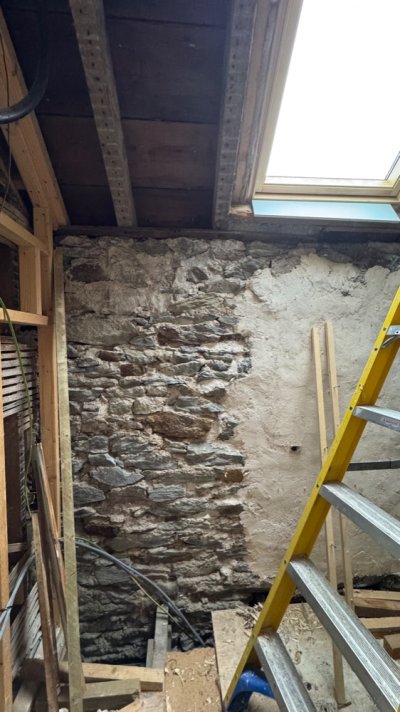
Stripping the ceiling revealed an interesting old detail. You can make out the remains of an arched opening that was lathed. I think there must have been a little dormer here that was removed at some point. I have an old postcard that shows the house in the distance taken at the end of the 19th C and you can just about make out something that could have been a dormer. There was also a vertical stud set into the masonry below this that was very rotten. I'm guessing the dormer was removed when the house was re-roofed in the mid 20th C. since all the slates on the front face seem to match.
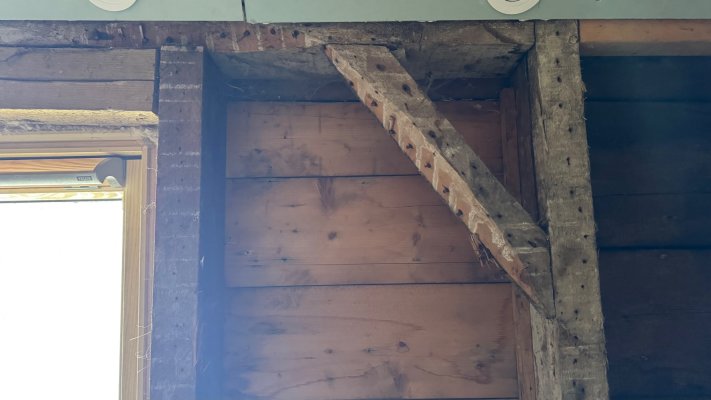
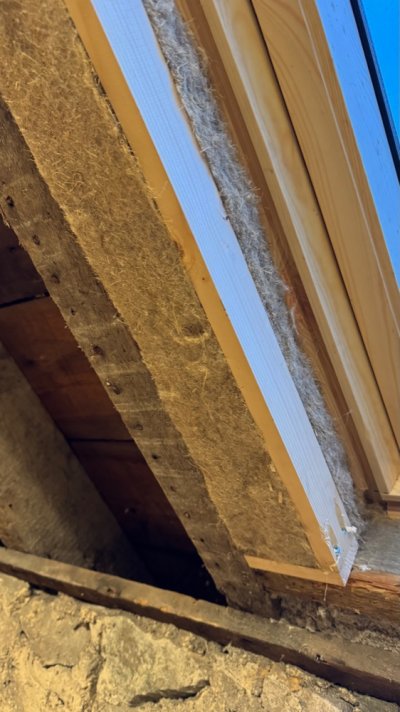
I've trimmed and insulated with hemp around the newly fitted Velux. Can no longer feel any air movement around the window frame, good.
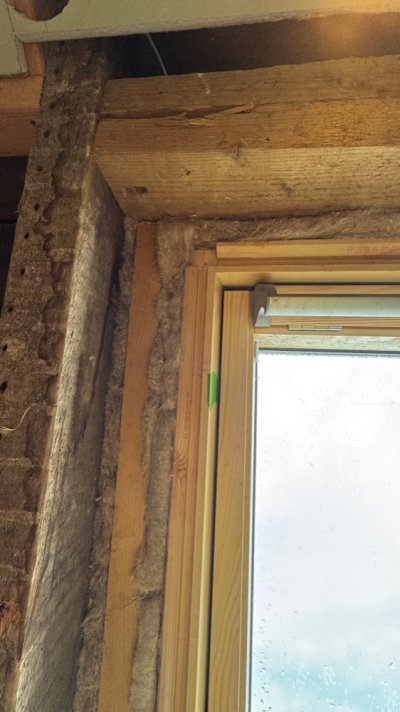
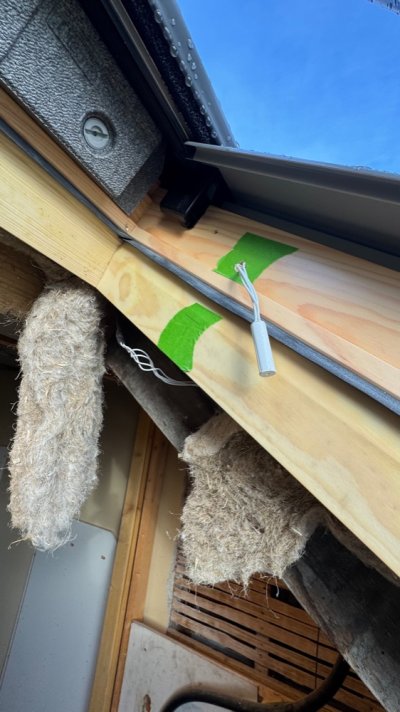
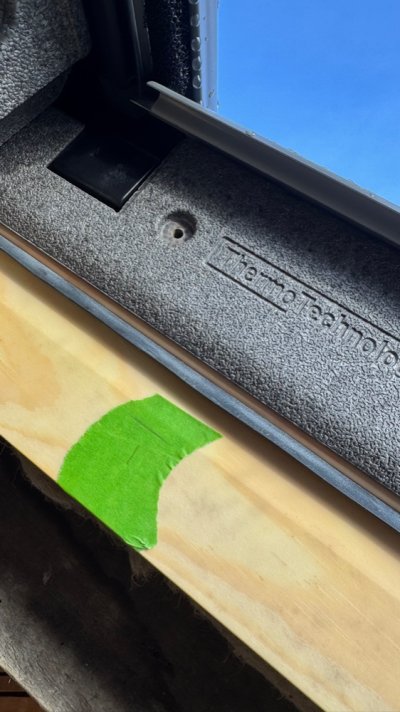
One of my little obsessions.. As I overhaul each window I add concealed alarm contacts. At first I couldn't figure out how I was going to do this because either the case or the sash have those very technical looking grey mouldings on them, but they can just be unscrewed to reveal the case. Still have to put a magnet on the sash. Obviously its pretty unlikely anyone is going to break in through a roof light but the contact can be useful for automation things like turning off the heating if the window is left open or sending a notification to remember to close it.
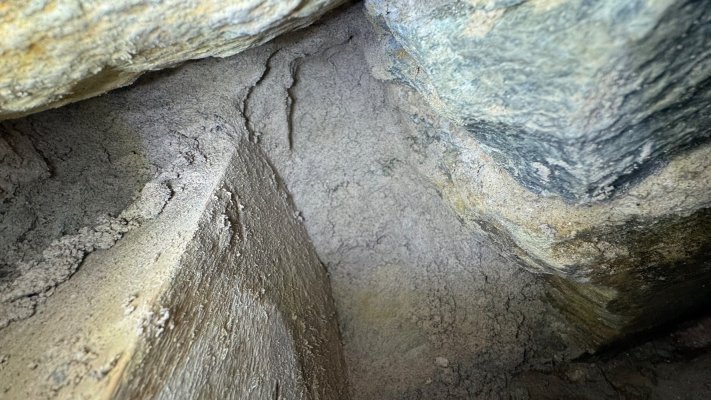
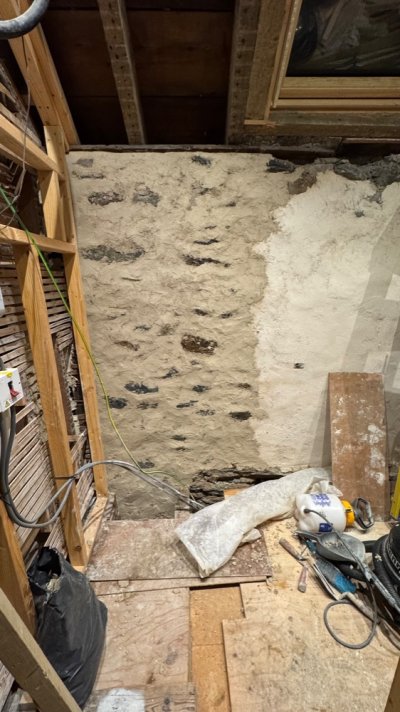
More parging done yesterday. This is Adaptavate Breathaplasta. Which I realise isn't to everyone's taste. It suits me though, goes on easily for someone like me with terrible trowel skills. Going a bit thinner this time and leaving some of the stones exposed. It only needs to be smooth enough for the hemp to conform to it and the hemp has better thermal performance so the more of that the better. I only have about 50mm max here for the hemp.
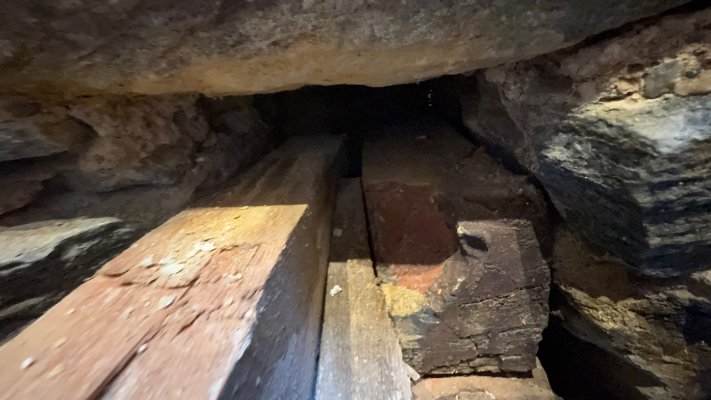
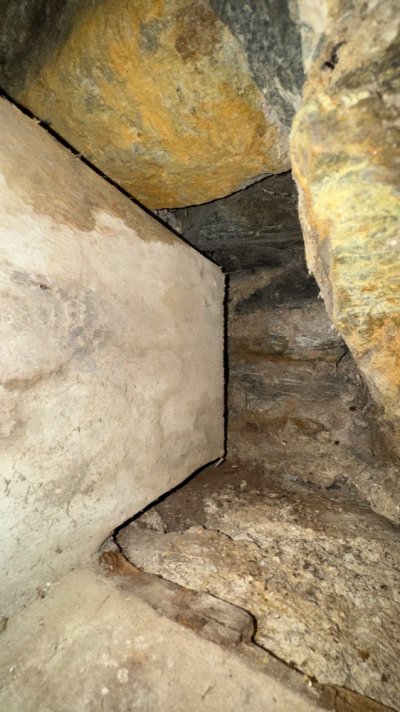
I carried the parge coat all the way down between the joists to the wall plate in the first bay. The intention is that the wall insulation will extend down to below the underfloor insulation to give a continuous layer. The front door vestibule is below here so the floor needs to be made very airtight and well insulated.
This room was a Jack and Jill shower room when we moved in accessed from the original door in the hallway and a new doorway that had been unsympathetically knocked through from the main bedroom. At 9'x8' its quite a generous size which doesn't really explain why it used to house the world's smallest shower cubicle containing the world's weakest electric shower. Luxury it was not and it was the only shower for the whole house at the time. That's all been swept away and the room stripped to bare walls and rafters.
Which is when problems came to light. Several of the joist ends were barely hanging on and with the ceiling stripped you could see the backs of the sarking boards just above the wall head were soaking. I thought this must be due to a badly detailed overflow pipe for the old cistern in the loft but with that deleted and slated over it was still wet. Then I happened to spot a flash of light between the sarking boards coming from below the valley gutter. Closer examination revealed a pin hole in the valley that was allowing water to soak in. I believe that over time this took out the joist ends and also the front door lintel below. All completely hidden from view, possibly going on for decades. That's all been fixed (almost, see later).
The plan for the room is to split it into two and have an ensuite accessed only from the bedroom and another room accessed from the hall. This second room could potentially be fitted out as another shower room but we'll probably use it for storage. Both rooms will be pretty tight but I'll still be able to fit in a bigger shower than before.
I'm going to be practicing what I preach trying to stay true to the breathable mantra as far as possible as I build it back up. It'll be basically the same IWI system as I used in the downstairs room -- a parge/dub coat of insulating plaster, studwork holding flexible hemp batts, wood wool boards and lime plaster. The shower area will be cement board though. There will be UFH and I've already cut away the floor boards (none in decent shape) and put wood fibre insulation between the floor joists. Last time around I had started on the parge coat.
Here's where I picked up. The new partition will go side to side so the front half gets the rooflight and the rear half won't have any natural light. This will somewhat reduce the amount of light reaching the top landing if all the bedroom doors are closed. I did consider splitting front to back so that both rooms could have light but that would have meant rejigging the roof to fit two rooflights and getting the soil pipe to both halves would have been problematic. Too big a job, see, sometimes I'm sensible...
Stripping the ceiling revealed an interesting old detail. You can make out the remains of an arched opening that was lathed. I think there must have been a little dormer here that was removed at some point. I have an old postcard that shows the house in the distance taken at the end of the 19th C and you can just about make out something that could have been a dormer. There was also a vertical stud set into the masonry below this that was very rotten. I'm guessing the dormer was removed when the house was re-roofed in the mid 20th C. since all the slates on the front face seem to match.
I've trimmed and insulated with hemp around the newly fitted Velux. Can no longer feel any air movement around the window frame, good.
One of my little obsessions.. As I overhaul each window I add concealed alarm contacts. At first I couldn't figure out how I was going to do this because either the case or the sash have those very technical looking grey mouldings on them, but they can just be unscrewed to reveal the case. Still have to put a magnet on the sash. Obviously its pretty unlikely anyone is going to break in through a roof light but the contact can be useful for automation things like turning off the heating if the window is left open or sending a notification to remember to close it.
More parging done yesterday. This is Adaptavate Breathaplasta. Which I realise isn't to everyone's taste. It suits me though, goes on easily for someone like me with terrible trowel skills. Going a bit thinner this time and leaving some of the stones exposed. It only needs to be smooth enough for the hemp to conform to it and the hemp has better thermal performance so the more of that the better. I only have about 50mm max here for the hemp.
I carried the parge coat all the way down between the joists to the wall plate in the first bay. The intention is that the wall insulation will extend down to below the underfloor insulation to give a continuous layer. The front door vestibule is below here so the floor needs to be made very airtight and well insulated.