
Tnono
Member
- Messages
- 2
- Location
- Sydney Australia
Here’s the CONTEXT:
175-year-old sandstone cottage.
Prior paint showed signs of rising damp so I:
Installed subfloor ventilation
Stripped the original internal render (mix of lime + later cement patching) to let walls breathe.
This has solved the dampness (smell and touch) so far.
ISSUE:
Exposed sandstone is generally sound for its age (no major structural loss) BUT dry brushing produces continuous fine dust (not just loose surface debris). Dust generation is repeatable with light brushing that suggests surface friability rather than isolated dirt. No obvious large-scale delamination, but grains are easily detached.
I’m concerned for my 12-month-old child; awareness of respirable silica risk. Is ongoing fine dust release from exposed internal sandstone a genuine health risk in a residential setting? Specifically: likelihood of respirable crystalline silica fraction vs benign?
If this poses a genuine health risk then the goal is to stabilise the surface enough to stop ongoing dust release and reduce airborne fines, while preserving permeability and long-term stone health.
Constraints for any treatment:
Vapour permeable (no sealing/film formation).
Avoid hydrophobic systems (acrylics/silanes/siloxanes).
Avoid products with known long-term incompatibility with heritage sandstone (e.g. some ethyl silicates if poorly matched).
No or minimal visible colour shift or darkening.
Prefer minimal chemical intrusion / reversible where possible.
AU availability
Penetrating consolidants (non-film forming):
Nanosilica (water-based): Chemforce Forti-Col;
Concern: Designed for cementitious matrices, not siliceous stone.
Bonding in sandstone is less chemically synergistic than in concrete
Ethyl silicate: Wacker OH series / Remmers KSE range
Concerns around application sensitivity and potential mismatch with softer stones.Technically superior, but high execution risk
There are other brands but I fear these create hydrophobic barriers:
Condense Plus: https://www.sealersplus.com.au/products/sealers/condense-plus/
Water-borne dust suppressants (breathable) e.g. PROSOCO Interior Masonry Dustproofer (difficult to source locally).
Concern: Introduces hydrophobic behaviour and alters moisture transport which is problematic in rising damp context
Ultra-dilute limewater consolidation: Westox Lime Wash
Ultra-thin limewash to bind surface fines.
Concern: aesthetic change (muting/whitening of stone), even if diluted.
What I after:
Confirmation whether this scenario constitutes a meaningful indoor air hazard (especially for infants), or if risk is typically overstated outside of active cutting/grinding contexts.
Treatment advice with product-level recommendations available in Australia that:
Consolidate friable sandstone or suppress dust,
Remain vapour permeable,
Are non-hydrophobic,
Have low risk of long-term damage or salt trapping,
Do not noticeably alter appearance.
And if there’s a sensible order to try various approaches. Really appreciate any feedback. Tumbling down a sandstone rabbit hole atm!
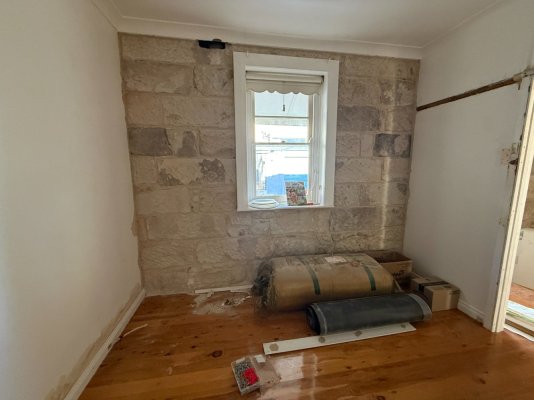
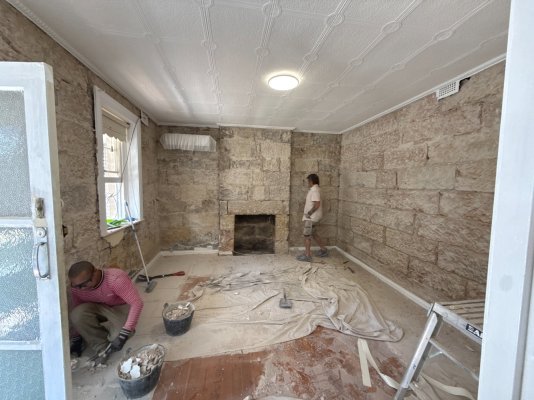
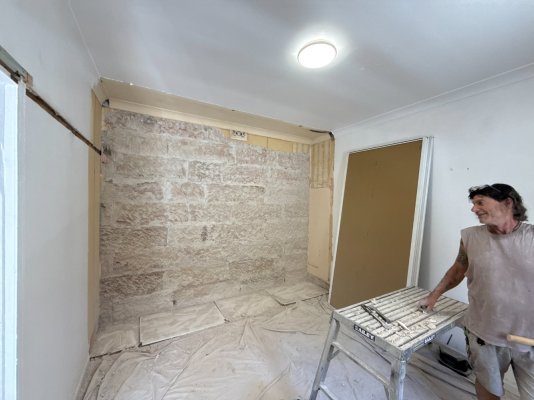
175-year-old sandstone cottage.
Prior paint showed signs of rising damp so I:
Installed subfloor ventilation
Stripped the original internal render (mix of lime + later cement patching) to let walls breathe.
This has solved the dampness (smell and touch) so far.
ISSUE:
Exposed sandstone is generally sound for its age (no major structural loss) BUT dry brushing produces continuous fine dust (not just loose surface debris). Dust generation is repeatable with light brushing that suggests surface friability rather than isolated dirt. No obvious large-scale delamination, but grains are easily detached.
I’m concerned for my 12-month-old child; awareness of respirable silica risk. Is ongoing fine dust release from exposed internal sandstone a genuine health risk in a residential setting? Specifically: likelihood of respirable crystalline silica fraction vs benign?
If this poses a genuine health risk then the goal is to stabilise the surface enough to stop ongoing dust release and reduce airborne fines, while preserving permeability and long-term stone health.
Constraints for any treatment:
Vapour permeable (no sealing/film formation).
Avoid hydrophobic systems (acrylics/silanes/siloxanes).
Avoid products with known long-term incompatibility with heritage sandstone (e.g. some ethyl silicates if poorly matched).
No or minimal visible colour shift or darkening.
Prefer minimal chemical intrusion / reversible where possible.
AU availability
Penetrating consolidants (non-film forming):
Nanosilica (water-based): Chemforce Forti-Col;
Concern: Designed for cementitious matrices, not siliceous stone.
Bonding in sandstone is less chemically synergistic than in concrete
Ethyl silicate: Wacker OH series / Remmers KSE range
Concerns around application sensitivity and potential mismatch with softer stones.Technically superior, but high execution risk
There are other brands but I fear these create hydrophobic barriers:
Condense Plus: https://www.sealersplus.com.au/products/sealers/condense-plus/
Water-borne dust suppressants (breathable) e.g. PROSOCO Interior Masonry Dustproofer (difficult to source locally).
Concern: Introduces hydrophobic behaviour and alters moisture transport which is problematic in rising damp context
Ultra-dilute limewater consolidation: Westox Lime Wash
Ultra-thin limewash to bind surface fines.
Concern: aesthetic change (muting/whitening of stone), even if diluted.
What I after:
Confirmation whether this scenario constitutes a meaningful indoor air hazard (especially for infants), or if risk is typically overstated outside of active cutting/grinding contexts.
Treatment advice with product-level recommendations available in Australia that:
Consolidate friable sandstone or suppress dust,
Remain vapour permeable,
Are non-hydrophobic,
Have low risk of long-term damage or salt trapping,
Do not noticeably alter appearance.
And if there’s a sensible order to try various approaches. Really appreciate any feedback. Tumbling down a sandstone rabbit hole atm!
