Rednaz
Member
- Messages
- 7
- Location
- North West
Hello all. Frantically Googling remedies and "good approaches" regarding my house continuously led me to this forum. No existing post I could find quite matched my situation, so I thought I'd just post instead.
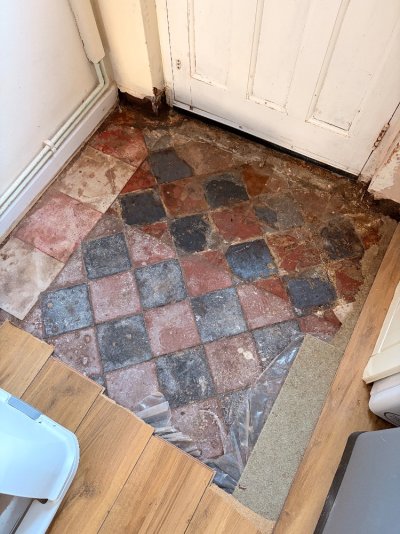
I have recently moved into a Victorian mid-terrace house. It's described as in "fair condition," which is pretty accurate. It's got suspended timber floors at the front and a solid concrete rear. Its main quirk you will all likely find interesting is that it has "finger" cavity walls, suspected to be an early experiment for cavity walls, but from the outside it looks like solid wall construction (mostly likely pseudo header bricks).
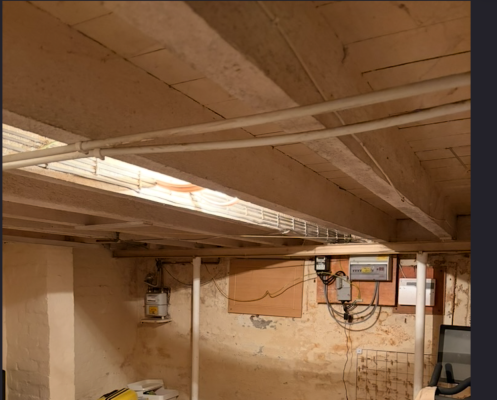
I'm posting because the house is a bit damp with a reasonably high RH. It's at 65% on the ground floor, and slightly lower (58%) at the first floor. The basement is sitting at closer to 80%. There's no obvious mould or damp patches around the house (aside from the basement), but my new dehumidifier is filling up a ton as part of my attempts to dry the place out (humidifier placed in a central location).
I had a survey done as required by my mortgage company when purchasing, and the usual "rising damp" suspicions were provided with the suggestion to hack off loads of the plaster and do a chemical DPC (classic). They identified that the ground level is damp both front and back (mostly at the lower level) and have also suggested that the original DPC is missing or failed. Naturally, I want to do everything I can in terms of simple remedial work and adjustments before resorting to chemicals and invasive work.
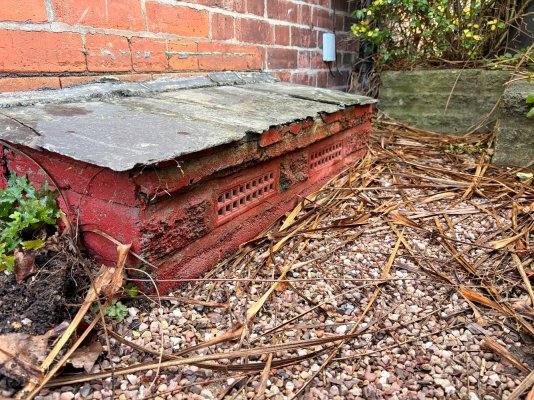
For ventilation, the front has air-bricks that are visible at the old coal chute location. I've checked that these are clear of debris. There's a basic extractor in the bathroom, but nothing in the kitchen. Subfloor ventilation seems quite limited as it's only the few air-bricks at the front and no cross ventilation due to the solid brick rear. There's also a "board" loosely attached to the wall (there's a gap behind it), but I’m thinking I might need to remove it (photos below).
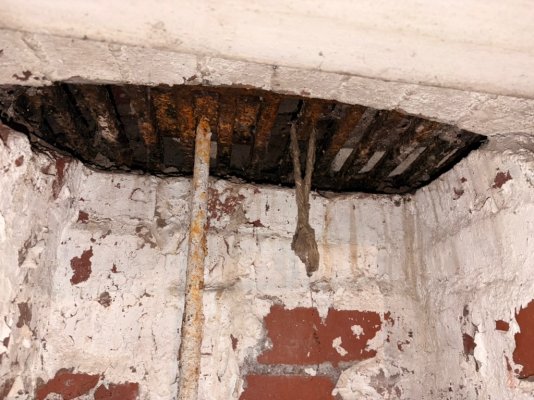
on right right is what I believe to be the old coal chute, the air bricks are just above that metal grill. What you can see on the right is behind the wooden board you can see on the left!
For potential water sources, chimneys are present but sealed with air-bricks internally. The chimneys are open at the pot, but I have booked a contractor to come and install a cowls to prevent water ingress. That same contractor is also going to ensure my gutters are watertight to prevent penetrating damp from outside, I've looked at the gutters when its been chucking it down and they seem to be OK. Pointing is generally in OK shape, but I'm planning on getting it touched up in the new year.
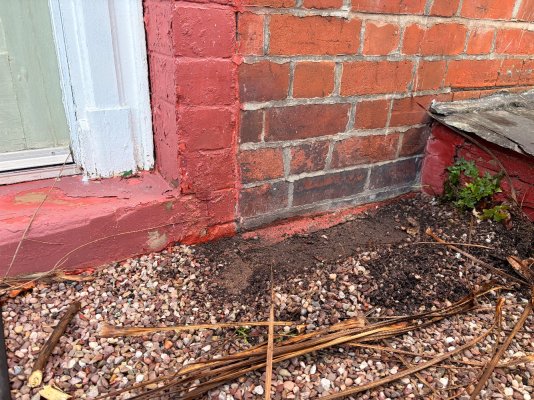
Current plans are to install a humidistat extractor in the kitchen as well as upgrade the one in the bathroom. I'm also running a continuous heat of around 20°C and running my dehumidifier 24/7 (the property was empty with no heating for months). I'm looking for other suggestions for what else I can do, or what else might be causing my damp. I'm a bit suspicious of the ground levels at the rear and front and although I can't see the DPC, I'm suspicious of the surveyor that it is "missing".
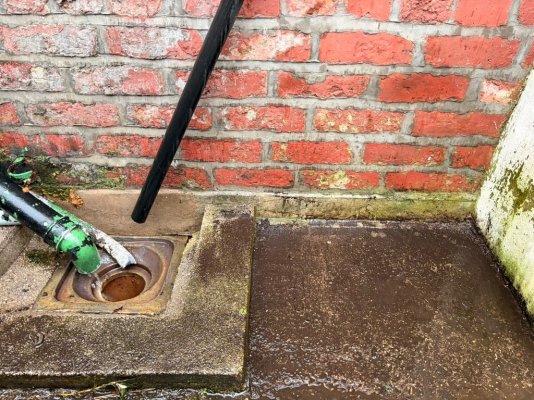
This is the rear. The concrete line you can see is the internal floor.
Happy to take more photos if anyone has any other thoughts!
I have recently moved into a Victorian mid-terrace house. It's described as in "fair condition," which is pretty accurate. It's got suspended timber floors at the front and a solid concrete rear. Its main quirk you will all likely find interesting is that it has "finger" cavity walls, suspected to be an early experiment for cavity walls, but from the outside it looks like solid wall construction (mostly likely pseudo header bricks).
I'm posting because the house is a bit damp with a reasonably high RH. It's at 65% on the ground floor, and slightly lower (58%) at the first floor. The basement is sitting at closer to 80%. There's no obvious mould or damp patches around the house (aside from the basement), but my new dehumidifier is filling up a ton as part of my attempts to dry the place out (humidifier placed in a central location).
I had a survey done as required by my mortgage company when purchasing, and the usual "rising damp" suspicions were provided with the suggestion to hack off loads of the plaster and do a chemical DPC (classic). They identified that the ground level is damp both front and back (mostly at the lower level) and have also suggested that the original DPC is missing or failed. Naturally, I want to do everything I can in terms of simple remedial work and adjustments before resorting to chemicals and invasive work.
For ventilation, the front has air-bricks that are visible at the old coal chute location. I've checked that these are clear of debris. There's a basic extractor in the bathroom, but nothing in the kitchen. Subfloor ventilation seems quite limited as it's only the few air-bricks at the front and no cross ventilation due to the solid brick rear. There's also a "board" loosely attached to the wall (there's a gap behind it), but I’m thinking I might need to remove it (photos below).
on right right is what I believe to be the old coal chute, the air bricks are just above that metal grill. What you can see on the right is behind the wooden board you can see on the left!
For potential water sources, chimneys are present but sealed with air-bricks internally. The chimneys are open at the pot, but I have booked a contractor to come and install a cowls to prevent water ingress. That same contractor is also going to ensure my gutters are watertight to prevent penetrating damp from outside, I've looked at the gutters when its been chucking it down and they seem to be OK. Pointing is generally in OK shape, but I'm planning on getting it touched up in the new year.
Current plans are to install a humidistat extractor in the kitchen as well as upgrade the one in the bathroom. I'm also running a continuous heat of around 20°C and running my dehumidifier 24/7 (the property was empty with no heating for months). I'm looking for other suggestions for what else I can do, or what else might be causing my damp. I'm a bit suspicious of the ground levels at the rear and front and although I can't see the DPC, I'm suspicious of the surveyor that it is "missing".
This is the rear. The concrete line you can see is the internal floor.
Happy to take more photos if anyone has any other thoughts!