
Sunshine99
Member
- Messages
- 29
- Location
- Worcestershire
A few months ago I posted here to see if anyone had any experience of using the Ecotiffin Air Drain product - it’s effectively a prefabricated Zebcolm Trench, to use the local vernacular. I didn’t get any responses, but I’ve gone ahead and done it anyway - so this is the post that I had hoped to find, in the hope that it will be useful to others.
The starting point is a standard problem - the ground level outside is too high in relation to the internal floor level, potentially contributing to damp issues. This is an 1840s brick house (three floors). Two of the sides of the house aren’t suitable for this approach but the other two have a completely flat surrounding area, covered with gravel, with no slope to gather and direct surface water at the house. This seems like an ideal place for some sort of trench solution.
These two sides total 18m in length, but after deductions for door openings and a section that I knew would be tricky due to a drain, that left about 10m that could be potentially trenched. I looked at the “Zebcolm Trench”, much discussed in these parts. If I were able to do this work myself, I would certainly have considered this approach. But I can’t - I’d have to pay someone else to do it, and that would not be cheap. And this is where the Ecotiffin Air Drain comes in: the product is expensive to buy (nearly £200/metre once you’ve added extras, delivery and VAT) but cheap to install, and is potentially a much neater solution in the end.
You just dig a trench, pop some gravel in the bottom to get it level, stick the Air Drain unit in the trench, and backfill with gravel. Job done. No wall to build (with its own footings), no grille to think about. Just a more or less instant trench to ventilate the wall. You could, if you wanted, lay it on top of a drain of some sort. They'll make it in a wide variety of sizes but I went for 15x20cm.
I did some trial digs to see what I was dealing with, and found what looked like an ideal situation: the wall went straight down, just mud up against it with gravel over the top. So I hired someone to do the work, bought 10m of the Air Drain product, and it’s now complete. Well, sort of.
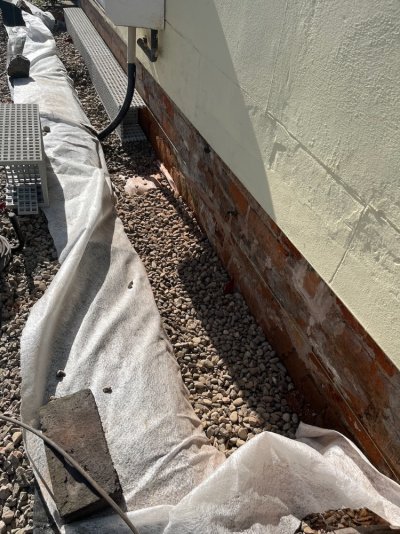
The main problem I had I’ve referenced in another thread - it turned out that my trial digs were unfortunately chosen, because in other areas the wall is very shallow indeed - barely more than one brick course below the internal floor level. Digging a trench here would simply be undermining the house and completely pointless as all it would be doing is ventilating mud… In other places, there is another line of bricks but it is stepped out (as footings often are). The result is that I’ve actually only been able to lay about 5m of Air Drain: in the other areas we’ve just removed some of the mud (taking care to avoid undermining the wall) and replaced it with additional gravel.
However - and this is the main point - in the areas where the wall was more conventional, the Air Drain went down very easily. Dig the trench, gravel underneath to level, lay the units, backfill. Just make sure that the backfilling gravel is big enough (20mm), otherwise it will come through the holes.
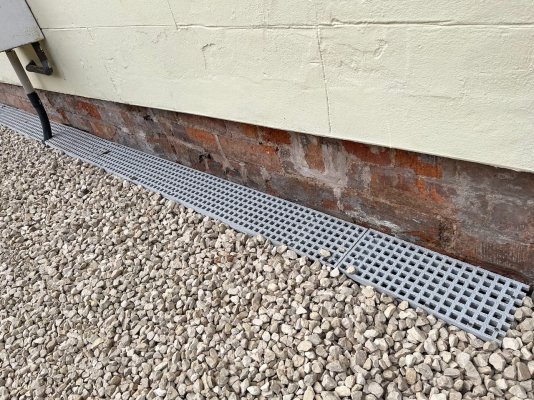
The product itself is eye-wateringly expensive for what it is, but in an appropriate environment it does what it says on the tin. Reasonably easy to cut and shape where there are pipes or irregular bits of wall to deal with. The company is very a small outfit in Hemel Hempstead - don’t expect any useful website or documentation. The people are friendly enough - I had some useful conversations on the phone - but there aren’t many of them.
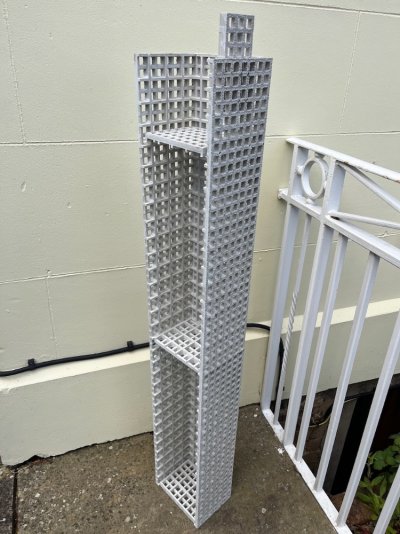
One catch is that they won’t take my unused units (4no 125x20x15cm) back as returns, even though they are in pristine condition. If anyone would be interested in taking them off my hands at a discounted price, send me a PM through this site to discuss. Delivery may be available, or we could meet halfway…
The starting point is a standard problem - the ground level outside is too high in relation to the internal floor level, potentially contributing to damp issues. This is an 1840s brick house (three floors). Two of the sides of the house aren’t suitable for this approach but the other two have a completely flat surrounding area, covered with gravel, with no slope to gather and direct surface water at the house. This seems like an ideal place for some sort of trench solution.
These two sides total 18m in length, but after deductions for door openings and a section that I knew would be tricky due to a drain, that left about 10m that could be potentially trenched. I looked at the “Zebcolm Trench”, much discussed in these parts. If I were able to do this work myself, I would certainly have considered this approach. But I can’t - I’d have to pay someone else to do it, and that would not be cheap. And this is where the Ecotiffin Air Drain comes in: the product is expensive to buy (nearly £200/metre once you’ve added extras, delivery and VAT) but cheap to install, and is potentially a much neater solution in the end.
You just dig a trench, pop some gravel in the bottom to get it level, stick the Air Drain unit in the trench, and backfill with gravel. Job done. No wall to build (with its own footings), no grille to think about. Just a more or less instant trench to ventilate the wall. You could, if you wanted, lay it on top of a drain of some sort. They'll make it in a wide variety of sizes but I went for 15x20cm.
I did some trial digs to see what I was dealing with, and found what looked like an ideal situation: the wall went straight down, just mud up against it with gravel over the top. So I hired someone to do the work, bought 10m of the Air Drain product, and it’s now complete. Well, sort of.
The main problem I had I’ve referenced in another thread - it turned out that my trial digs were unfortunately chosen, because in other areas the wall is very shallow indeed - barely more than one brick course below the internal floor level. Digging a trench here would simply be undermining the house and completely pointless as all it would be doing is ventilating mud… In other places, there is another line of bricks but it is stepped out (as footings often are). The result is that I’ve actually only been able to lay about 5m of Air Drain: in the other areas we’ve just removed some of the mud (taking care to avoid undermining the wall) and replaced it with additional gravel.
However - and this is the main point - in the areas where the wall was more conventional, the Air Drain went down very easily. Dig the trench, gravel underneath to level, lay the units, backfill. Just make sure that the backfilling gravel is big enough (20mm), otherwise it will come through the holes.
The product itself is eye-wateringly expensive for what it is, but in an appropriate environment it does what it says on the tin. Reasonably easy to cut and shape where there are pipes or irregular bits of wall to deal with. The company is very a small outfit in Hemel Hempstead - don’t expect any useful website or documentation. The people are friendly enough - I had some useful conversations on the phone - but there aren’t many of them.
One catch is that they won’t take my unused units (4no 125x20x15cm) back as returns, even though they are in pristine condition. If anyone would be interested in taking them off my hands at a discounted price, send me a PM through this site to discuss. Delivery may be available, or we could meet halfway…