
Hi all,
I'm finally on to working on the last room in a Victorian terraced house that I bought around 4 years ago. This was the room at the rear of the house, and upon taking up the old carpet, it was obvious it has had some damp issues (lots of woodworm and spongy feeling floorboards). I have been told the wood worm appears to have been treated at some point and appears inactive. I'm not 100% sure where the damp stems from, but I know the ground level outside this room in the garden is too high, and the airbricks at the back of the room were covered up by a conservatory, both of which I'll be fixing shortly. I'm also hoping that underneath the conservatory slab I'll find some drainage access that was covered up, so I can have those surveyed too.
Anyway, I've pulled up all of the boards to expose the subfloor and suspended timber structure and I was looking for some advice on what to do. My immediate thought was that it could benefit from being entirely replaced, due to the state and construction of the foundational brick piers that the sleeper timbers are sat on, but I don't want to overreact. Ideally I suppose I'd like to do the minimum amount possible really. I plan to just have bare floorboards in this room (it will be a kitchen). I'll insulate between the joists and lay "new" reclaimed boards eventually.
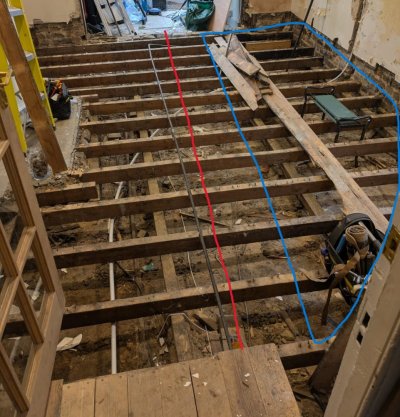
Here's a general overview pic of the floor. I've highlighted the side with the particularly bad rot issues in blue. You can see some historic bodging has gone on.
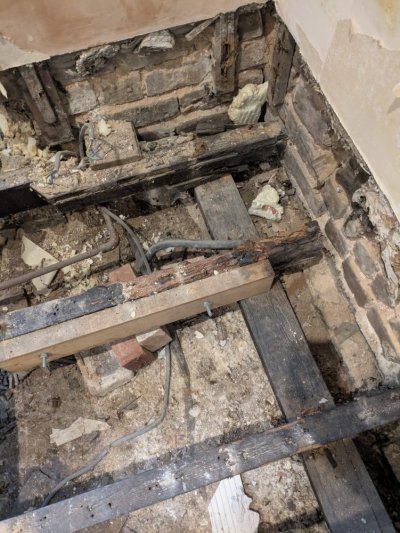
Here's a close up of some of the damage on that side:
I was wondering if I could just cut the joists along the red line, sister them up and level them out and perhaps terminate them into joist hangers when they meet the wall. Some are also quite twisted at that side, so this would give me the opportunity to level them out and add some noggins for support.
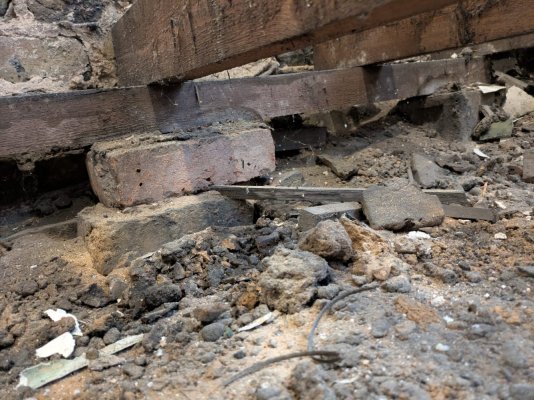
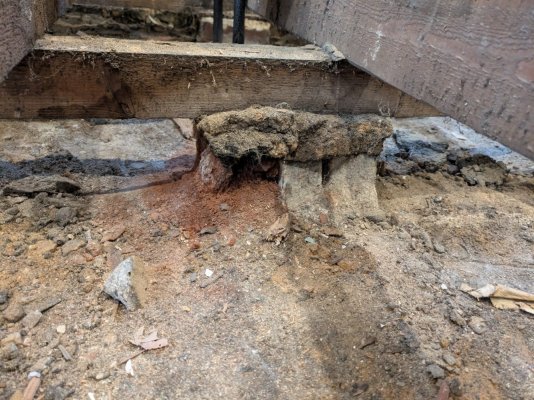
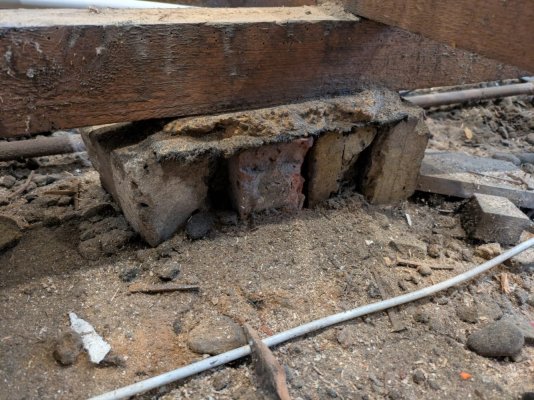
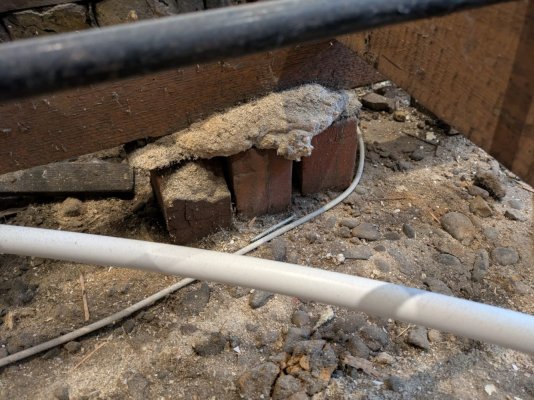
The thing that concerns me though is the state of the brick piers everywhere being used to support the sleeper timbers that in turn support the joists. In some cases they're just a pile of loose bricks that no longer even make contact with the timber. In other cases they do still make contact, but seem a bit ramshackle and don't seem to be bonded together with any mortar. Some of the bricks are crumbling and some timbers seem to be bedded in on a layer of what I think is old sandy mortar. Here are a handful of examples:
Any advice would be greatly appreciated. I don't want to do more work than is needed, but also don't want to cut corners. In the event I did need to rebuild the brick piers, I did have a couple of questions regarding if they needed any sort of foundation and also if using blockwork was acceptable? (although not obviously not strictly a period accurate thing...)
Thanks!
I'm finally on to working on the last room in a Victorian terraced house that I bought around 4 years ago. This was the room at the rear of the house, and upon taking up the old carpet, it was obvious it has had some damp issues (lots of woodworm and spongy feeling floorboards). I have been told the wood worm appears to have been treated at some point and appears inactive. I'm not 100% sure where the damp stems from, but I know the ground level outside this room in the garden is too high, and the airbricks at the back of the room were covered up by a conservatory, both of which I'll be fixing shortly. I'm also hoping that underneath the conservatory slab I'll find some drainage access that was covered up, so I can have those surveyed too.
Anyway, I've pulled up all of the boards to expose the subfloor and suspended timber structure and I was looking for some advice on what to do. My immediate thought was that it could benefit from being entirely replaced, due to the state and construction of the foundational brick piers that the sleeper timbers are sat on, but I don't want to overreact. Ideally I suppose I'd like to do the minimum amount possible really. I plan to just have bare floorboards in this room (it will be a kitchen). I'll insulate between the joists and lay "new" reclaimed boards eventually.
Here's a general overview pic of the floor. I've highlighted the side with the particularly bad rot issues in blue. You can see some historic bodging has gone on.
Here's a close up of some of the damage on that side:
I was wondering if I could just cut the joists along the red line, sister them up and level them out and perhaps terminate them into joist hangers when they meet the wall. Some are also quite twisted at that side, so this would give me the opportunity to level them out and add some noggins for support.
The thing that concerns me though is the state of the brick piers everywhere being used to support the sleeper timbers that in turn support the joists. In some cases they're just a pile of loose bricks that no longer even make contact with the timber. In other cases they do still make contact, but seem a bit ramshackle and don't seem to be bonded together with any mortar. Some of the bricks are crumbling and some timbers seem to be bedded in on a layer of what I think is old sandy mortar. Here are a handful of examples:
Any advice would be greatly appreciated. I don't want to do more work than is needed, but also don't want to cut corners. In the event I did need to rebuild the brick piers, I did have a couple of questions regarding if they needed any sort of foundation and also if using blockwork was acceptable? (although not obviously not strictly a period accurate thing...)
Thanks!
