
Rawler
Member
- Messages
- 25
- Location
- Darley Dale
Hello Community!
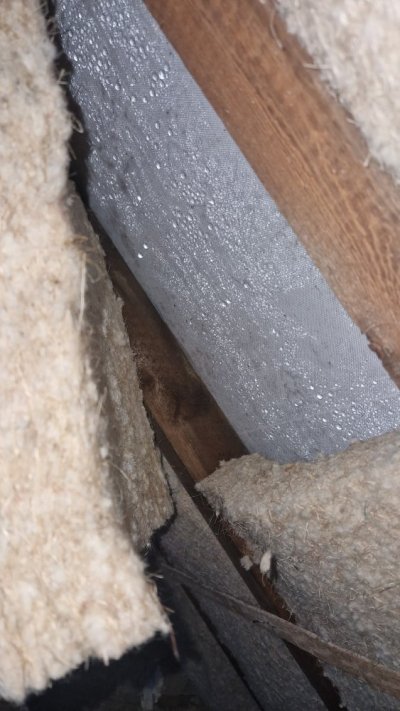
This is my loft insulation at stage 1. I am using sheeps wool between the rafters, well in this photo I have trialled sisal wool (cosy wool is in other parts, but the same effect is showing). I have left a rafter open (uninsulated) next to this one and there is no condensation in it. I am assuming this is a good example of intersidial condensation, although the amount suprised me really as the house is unheated (although obviously warmer than outside) nor any moisture heavy generators in the house as it's not being lived in. (There was some plastering done a couple of months ago although that had dried out and was ventilated.) The 'wool' seems to be doing its job and I would hope this moisture slowly finds its way out. I intend to go slowly and see how things develop over the year as I understand a breathable system works like this, although I like to see things for myself. So this is how a breathable system works in reality and it's seasonal and will dry throughout the non winter months and I shouldn't be concerned?? Obviously if I went on to make a room out of the space and added more insulation in theory there could be more condensation, more moisture and a steeper temperature gradient.
Has anyone any experience of this type of roof insulation build up?? It's similar to that being advocated by English Heritage. I was intending to go with wood fibre under this, but may stick with wool underneath or cork even? Some build ups advocate a vapour control layer below this to slow mositure accesing the roof, others say let it 'breathe' both ways.
FYI condensation is only on the northern roof, the south side is clear. For clarification, there is a small 25-30mm air gap between wool and membrane, but its not a ridge to eaves ventilated system, instead relying on natural air flow in roof and breathable membrane.
Any help or thoughts and hopefully similar experiences much appreciated.
This is my loft insulation at stage 1. I am using sheeps wool between the rafters, well in this photo I have trialled sisal wool (cosy wool is in other parts, but the same effect is showing). I have left a rafter open (uninsulated) next to this one and there is no condensation in it. I am assuming this is a good example of intersidial condensation, although the amount suprised me really as the house is unheated (although obviously warmer than outside) nor any moisture heavy generators in the house as it's not being lived in. (There was some plastering done a couple of months ago although that had dried out and was ventilated.) The 'wool' seems to be doing its job and I would hope this moisture slowly finds its way out. I intend to go slowly and see how things develop over the year as I understand a breathable system works like this, although I like to see things for myself. So this is how a breathable system works in reality and it's seasonal and will dry throughout the non winter months and I shouldn't be concerned?? Obviously if I went on to make a room out of the space and added more insulation in theory there could be more condensation, more moisture and a steeper temperature gradient.
Has anyone any experience of this type of roof insulation build up?? It's similar to that being advocated by English Heritage. I was intending to go with wood fibre under this, but may stick with wool underneath or cork even? Some build ups advocate a vapour control layer below this to slow mositure accesing the roof, others say let it 'breathe' both ways.
FYI condensation is only on the northern roof, the south side is clear. For clarification, there is a small 25-30mm air gap between wool and membrane, but its not a ridge to eaves ventilated system, instead relying on natural air flow in roof and breathable membrane.
Any help or thoughts and hopefully similar experiences much appreciated.
