
Morning all – hoping to get some advice on some pointing and foundation questions…
We bought a ~1880’s cottage and are in the gradual process of refurbishing and sorting out various issues. We’ve solid brick walls (mix of red rubbers and London stock), originally lime mortared and yes the previous owner has cement mortar pointed it in the past. We’ve opted for wood fibre insulation internally and so it’s especially important that one of my jobs now the weather has dried and warmed a bit is to rake out and repoint in lime - you can see my initial test area in the upper area of one of the pictures below, hopefully I’ll get neater with more practice and get less on the bricks!
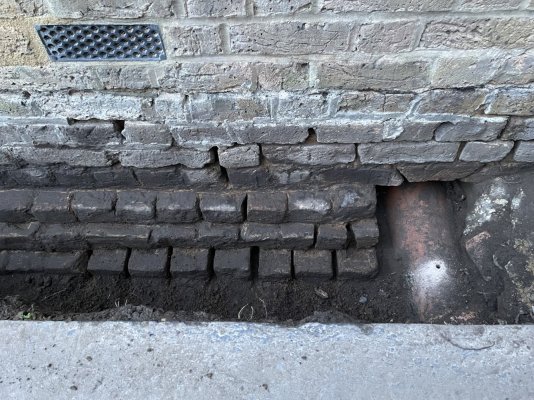
There was a bush against this wall, some of the roots had found there way through to the suspended floor internally, some through the pipe void which I will fill in once I have removed the pipe (it’s a disused pipe, this was an old stable\stalls and this is old drainage from the stalls to a cesspit) and a couple of smaller ones seem to have found their way through the lime mortar - I’ve excavated the corbelled footings and what you can see I have raked out so far was more earth than mortar, I haven’t started on the more sound mortar yet.
My intention with the foundations is to repoint old mortar with NHL mortar (the walls will be air lime mortar). The question I have is about the corbelled brick footing. The lower layer in contact with the ground, the lowest one you can see in the photo, does not appear to have mortar between them. It seems to be largely earth, possibly compacted and maybe more clay like than most of the other earth. Would this be normal\intentional, or would this have been lime mortar that has been replaced over 140 years of weathering and drainage? Should I repoint these joints with NHL?
One other question I have surrounds the DPC, which is a bitumen layer of some sort (though there is about 4” of plastic membrane under the air brick for some reason and on the left you can see the corner has had some work done in the past and also has some plastic membrane). There has been a little evidence of damp on this wall but I suspect it is from the fireplace on the other side (only recently opened up) and the chimney which does not have a cowl (yet), it does not seem to be manifesting as ‘rising’ damp. Either way I suspect the bitumen DPC as being largely intact and really do not want to replace entirely. How should I best tackle the repointing while maintaining the bitumen DPC? Do I mortar over it (potentially creating a bridge, albeit thin)? Or Do I rake out ever so carefully, repaint (again painstakingly carefully) with bitumen (have some Blackjack DPM from another job) so there is a continuous layer of bitumen from the existing old bitumen to the edge of the lower brick, and then repoint over the top? In my head that maintains a reasonable layer of bitumen DPC throughout.
Would appreciate and advice, thoughts, wise words, encouraging remarks etc!
Many thanks
Sqwim
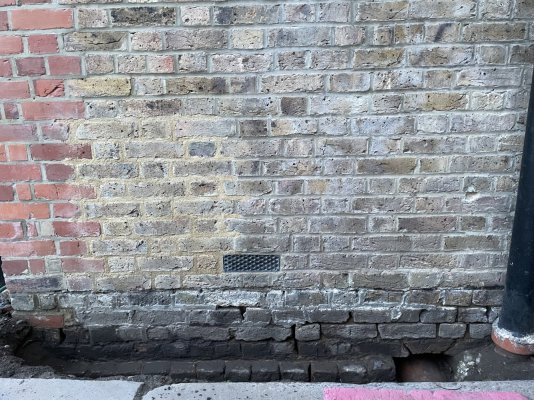
We bought a ~1880’s cottage and are in the gradual process of refurbishing and sorting out various issues. We’ve solid brick walls (mix of red rubbers and London stock), originally lime mortared and yes the previous owner has cement mortar pointed it in the past. We’ve opted for wood fibre insulation internally and so it’s especially important that one of my jobs now the weather has dried and warmed a bit is to rake out and repoint in lime - you can see my initial test area in the upper area of one of the pictures below, hopefully I’ll get neater with more practice and get less on the bricks!
There was a bush against this wall, some of the roots had found there way through to the suspended floor internally, some through the pipe void which I will fill in once I have removed the pipe (it’s a disused pipe, this was an old stable\stalls and this is old drainage from the stalls to a cesspit) and a couple of smaller ones seem to have found their way through the lime mortar - I’ve excavated the corbelled footings and what you can see I have raked out so far was more earth than mortar, I haven’t started on the more sound mortar yet.
My intention with the foundations is to repoint old mortar with NHL mortar (the walls will be air lime mortar). The question I have is about the corbelled brick footing. The lower layer in contact with the ground, the lowest one you can see in the photo, does not appear to have mortar between them. It seems to be largely earth, possibly compacted and maybe more clay like than most of the other earth. Would this be normal\intentional, or would this have been lime mortar that has been replaced over 140 years of weathering and drainage? Should I repoint these joints with NHL?
One other question I have surrounds the DPC, which is a bitumen layer of some sort (though there is about 4” of plastic membrane under the air brick for some reason and on the left you can see the corner has had some work done in the past and also has some plastic membrane). There has been a little evidence of damp on this wall but I suspect it is from the fireplace on the other side (only recently opened up) and the chimney which does not have a cowl (yet), it does not seem to be manifesting as ‘rising’ damp. Either way I suspect the bitumen DPC as being largely intact and really do not want to replace entirely. How should I best tackle the repointing while maintaining the bitumen DPC? Do I mortar over it (potentially creating a bridge, albeit thin)? Or Do I rake out ever so carefully, repaint (again painstakingly carefully) with bitumen (have some Blackjack DPM from another job) so there is a continuous layer of bitumen from the existing old bitumen to the edge of the lower brick, and then repoint over the top? In my head that maintains a reasonable layer of bitumen DPC throughout.
Would appreciate and advice, thoughts, wise words, encouraging remarks etc!
Many thanks
Sqwim