

fernicarry
Member
- Messages
- 960
- Location
- Argyllshire
The outdoor season has kicked off so once again I am outdoors working at height. Picking up from last year I'm finishing off tidying up the big front gable with the intention of working my way across the rest of the front of the house before tackling the north elevation. The north elevation having been the objective of last summer's activities but I didn't quite get that far...
Regular viewers will remember that I did the south gable last summer ending up at the junction between it and the big front gable. I'm pleased to report the new downpipe arrangements to drain the valley between those two gables have worked flawlessly over the winter, for probably the first time in decades, and there have been no drips or leaks. As part of the shower room refit I had to repair the valley rafter on the right hand side of the front gable so I'm starting off by tidying up that area. Should be a quick one!
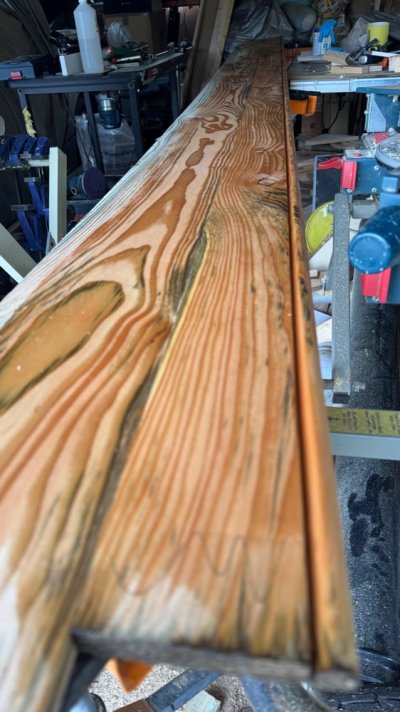
First task was to remake the fascia along the eaves to the right of the gable. This suffered some collateral damage whilst I was getting access to the valley rafter but also I wanted to remake it with a corner bead along the bottom edge to match the original fascias on the eaves at the back of the house. Trying to put back a little bit of the architectural detail that's been lost from the roofline with successive generations of replacement. It needs to be about 8" wide and my stock of larch boards are 6" wide, or more like 4" once planed and ripped straight, so its made from two pieces T&G jointed. The gods were smiling (or lulling me into a false sense of security) and the two pieces fitted together perfectly flush.
Whilst that piece is working its way through the paint shop I started examining the right hand side of the big front gable. I knew the bottom corner was a bit rotten so would need patched. The Chuckle Brothers who put it together basically used silicone mastic as an adhesive and a gap filler on everything so any soft pine that was in contact with the mastic has turned to weetabix and the arrangements for the valley on this side to drain into the gutter weren't doing the best job of keeping the woodwork dry.
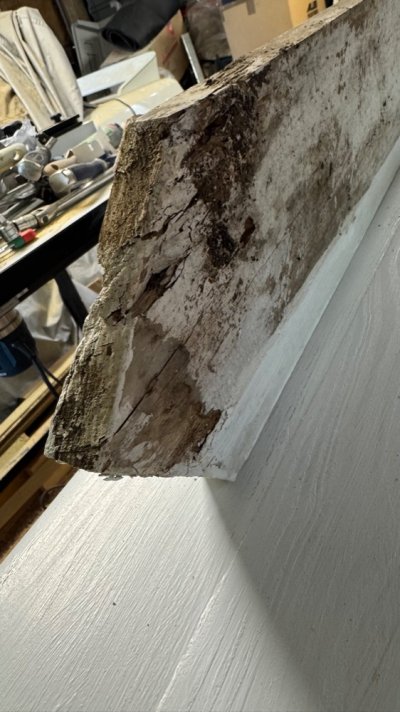
This is the bottom corner cut off of the fascia.
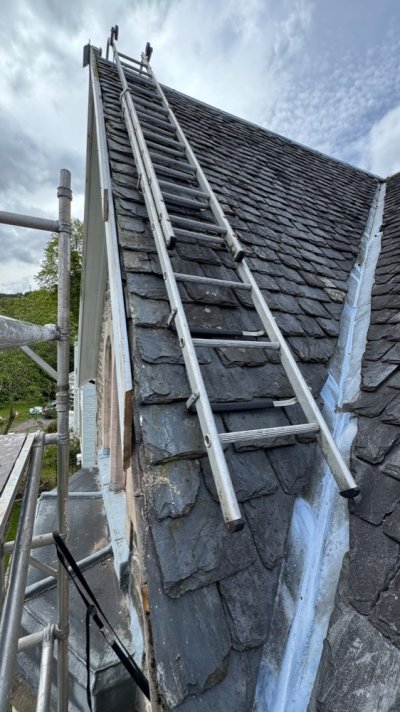
At this point the rest of it seemed to be solid so the plan was to cut back the lower end of the two pieces that make up the fascia and joint in replacements. The slate board was also quite rotten at the bottom edge but I'll replace that in its entirety since it takes quite a beating from the weather and pine doesn't last any length of time there.
Of course I wasn't going to get off as lightly as that.
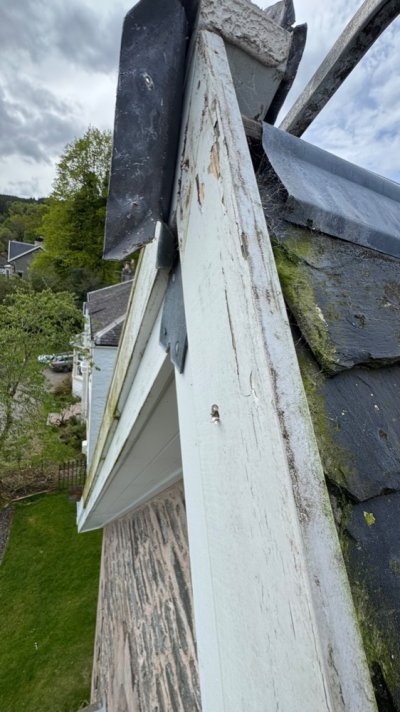
Closer examination of the top of the upper fascia board found it to be very soft for the first 18" or so. Instead of mucking about cutting in a repair piece, which would be a bit of a nightmare working off the roof ladder anyway, I just jettisoned the whole piece.
With that out of the way closer examination of the main fascia board showed it to have a quite soft section about half way along. This board has already had a repair cut in towards the top on the last repair cycle so cutting out the middle as well as repairing the bottom edge was going to leave it like a bit of a lace doily.
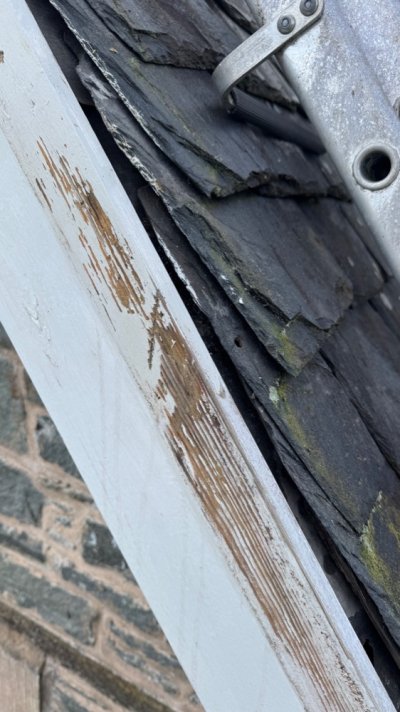
Given that the soft bit was behind the upper board I initially decided I'd just treat it and paint over it and stick my head back in the sand hoping to put it off for a few more years. But after a night's sleep, better sense prevailed and I decided I would repair it after all. The cut edges are perfectly dry and solid so hopefully that will arrest the rot in this area. These big pine boards seem to do this. Majority of it will be absolutely fine then you find a 6" section that has turned completely to mush.
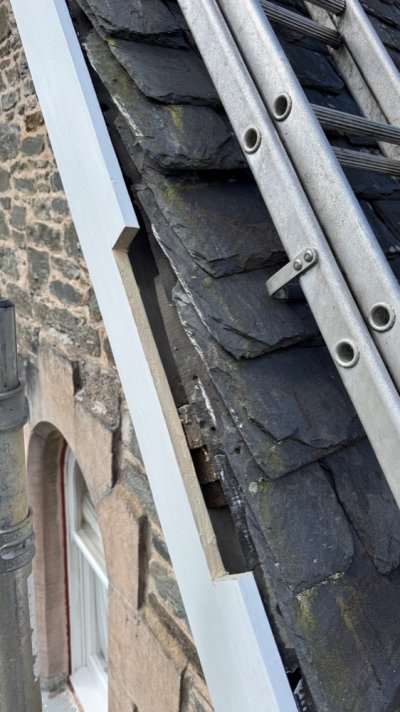
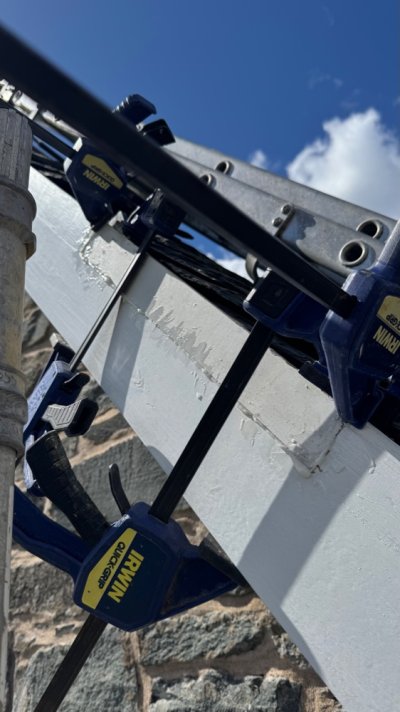
Whilst the glue was drying I removed the fascia across the eaves. This came off in two ways -- gradually, then suddenly! With all the screws out it didn't want to move, then it did, and it was suddenly extremely, blooming heavy, especially given that I was still holding the driver in one hand so had 3m of heavy wet pine in the other. We can laugh about it now...
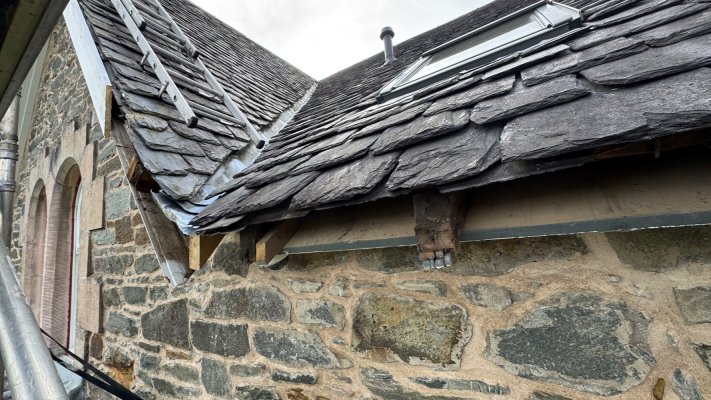
You can see my new valley rafter sticking out furthest to the left. Removing the fascia earlier would have made that job easier but then I would have lost my point of reference for where it was supposed to land and I would also have lost a functioning gutter which until recently was very much required. Although a couple of hours after this was taken we had a freak crazy heavy hail storm. That definitely wasn't in the forecast...
Much to my surprise the rest of the rafter ends are in absolutely perfect condition. For something that has spent 160 years facing onto a sea loch that is. Really very decent indeed. Good old Dougie Fir.
The soffit boards aren't original and at 21mm thick are quite over-engineered. The ones I make are 5/8" and tongue and grooved but as they are solid they can stay. What isn't quite right is the bevel on the outer edge of the row nearest the front hasn't been cut at a sufficiently steep angle leaving a gap where they met the back of the fascia board. As that offends my OCD I've removed them and remade them from offcuts from the scrapped gable fascia.
So that's this area disassembled, new pieces templated and now working their way through various stages of the Jotun treatment. With any luck it should all go back together in the next few days.
Regular viewers will remember that I did the south gable last summer ending up at the junction between it and the big front gable. I'm pleased to report the new downpipe arrangements to drain the valley between those two gables have worked flawlessly over the winter, for probably the first time in decades, and there have been no drips or leaks. As part of the shower room refit I had to repair the valley rafter on the right hand side of the front gable so I'm starting off by tidying up that area. Should be a quick one!
First task was to remake the fascia along the eaves to the right of the gable. This suffered some collateral damage whilst I was getting access to the valley rafter but also I wanted to remake it with a corner bead along the bottom edge to match the original fascias on the eaves at the back of the house. Trying to put back a little bit of the architectural detail that's been lost from the roofline with successive generations of replacement. It needs to be about 8" wide and my stock of larch boards are 6" wide, or more like 4" once planed and ripped straight, so its made from two pieces T&G jointed. The gods were smiling (or lulling me into a false sense of security) and the two pieces fitted together perfectly flush.
Whilst that piece is working its way through the paint shop I started examining the right hand side of the big front gable. I knew the bottom corner was a bit rotten so would need patched. The Chuckle Brothers who put it together basically used silicone mastic as an adhesive and a gap filler on everything so any soft pine that was in contact with the mastic has turned to weetabix and the arrangements for the valley on this side to drain into the gutter weren't doing the best job of keeping the woodwork dry.
This is the bottom corner cut off of the fascia.
At this point the rest of it seemed to be solid so the plan was to cut back the lower end of the two pieces that make up the fascia and joint in replacements. The slate board was also quite rotten at the bottom edge but I'll replace that in its entirety since it takes quite a beating from the weather and pine doesn't last any length of time there.
Of course I wasn't going to get off as lightly as that.
Closer examination of the top of the upper fascia board found it to be very soft for the first 18" or so. Instead of mucking about cutting in a repair piece, which would be a bit of a nightmare working off the roof ladder anyway, I just jettisoned the whole piece.
With that out of the way closer examination of the main fascia board showed it to have a quite soft section about half way along. This board has already had a repair cut in towards the top on the last repair cycle so cutting out the middle as well as repairing the bottom edge was going to leave it like a bit of a lace doily.
Given that the soft bit was behind the upper board I initially decided I'd just treat it and paint over it and stick my head back in the sand hoping to put it off for a few more years. But after a night's sleep, better sense prevailed and I decided I would repair it after all. The cut edges are perfectly dry and solid so hopefully that will arrest the rot in this area. These big pine boards seem to do this. Majority of it will be absolutely fine then you find a 6" section that has turned completely to mush.
Whilst the glue was drying I removed the fascia across the eaves. This came off in two ways -- gradually, then suddenly! With all the screws out it didn't want to move, then it did, and it was suddenly extremely, blooming heavy, especially given that I was still holding the driver in one hand so had 3m of heavy wet pine in the other. We can laugh about it now...
You can see my new valley rafter sticking out furthest to the left. Removing the fascia earlier would have made that job easier but then I would have lost my point of reference for where it was supposed to land and I would also have lost a functioning gutter which until recently was very much required. Although a couple of hours after this was taken we had a freak crazy heavy hail storm. That definitely wasn't in the forecast...
Much to my surprise the rest of the rafter ends are in absolutely perfect condition. For something that has spent 160 years facing onto a sea loch that is. Really very decent indeed. Good old Dougie Fir.
The soffit boards aren't original and at 21mm thick are quite over-engineered. The ones I make are 5/8" and tongue and grooved but as they are solid they can stay. What isn't quite right is the bevel on the outer edge of the row nearest the front hasn't been cut at a sufficiently steep angle leaving a gap where they met the back of the fascia board. As that offends my OCD I've removed them and remade them from offcuts from the scrapped gable fascia.
So that's this area disassembled, new pieces templated and now working their way through various stages of the Jotun treatment. With any luck it should all go back together in the next few days.