Hi All,
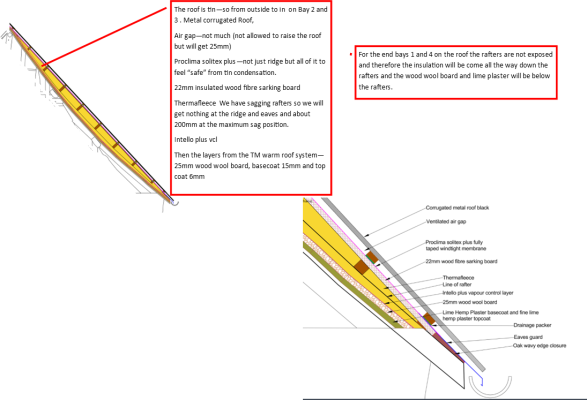
I am investigating insulation for the roof of a listed oak framed barn, stone built with a tin roof. The roof will be renewed, so work can be carried out from outside - roof timbers are mostly in good nick and we need to insulate and then replace the tin. I am using STBA "Moisture properties of insulation materials and their applicability to traditional construction" and English Heritage "Energy Efficiency and Historic Buildings - Insulating roofs at rafter level". I've also found Historic Environment Scotland "Inform Friday" youtube videos useful and looking at the Landmark Trust's refurbishment documents/planning/youtube for LLwyn Celyn and Calverley Hall. The Landmark Trust appear not to use a breather membrane or VCL (on these two projects) - they have stone slates on battern on woodfibre sarking boards above the rafters and then the systems vary slightly between and under the rafters (all breathable). We cannot raise the roof. Bats are catered for in a separate building. The system I am proposing is (leaving the 3" rafters on view)
Tin,
batten -Ventilation gap
Breathable but waterproof membrane (for dripping tin)
Batten Air gap - (not ventilated?)
Insulation - leaning towards wood fibre (we would like a layer on top of the rafters and then in between the rafters as well)
Lime plaster
We haven't got much room but there is some sag in the middle of the rafters i am hoping to use. I can scale this all out when the system is decided.
I'm still trying to work this out (and finding it pretty hard going) I normally like to follow a similar system like at LLwyn Celyn or Calverly Hall but we have the tin to deal with and the considerable condensation that is going happen and not having a membrane doesn't seem sensible.
I am wondering if it would be worth buying the tin already insulated with the aim of keeping the temperature above dew point? At the very minimum it will have to have a drip stop layer (we're in Mid Wales).
Can anyone comment on this or perhaps there is a refurbishment project with tin that you could point me to - Historic Environment Scotland has a lovely tin case study at Downie’s Cottage, Braemar but it has thatch under and lovely as that would be - heritage (and us too) like the tin.
thank you,
Lleuky
I am investigating insulation for the roof of a listed oak framed barn, stone built with a tin roof. The roof will be renewed, so work can be carried out from outside - roof timbers are mostly in good nick and we need to insulate and then replace the tin. I am using STBA "Moisture properties of insulation materials and their applicability to traditional construction" and English Heritage "Energy Efficiency and Historic Buildings - Insulating roofs at rafter level". I've also found Historic Environment Scotland "Inform Friday" youtube videos useful and looking at the Landmark Trust's refurbishment documents/planning/youtube for LLwyn Celyn and Calverley Hall. The Landmark Trust appear not to use a breather membrane or VCL (on these two projects) - they have stone slates on battern on woodfibre sarking boards above the rafters and then the systems vary slightly between and under the rafters (all breathable). We cannot raise the roof. Bats are catered for in a separate building. The system I am proposing is (leaving the 3" rafters on view)
Tin,
batten -Ventilation gap
Breathable but waterproof membrane (for dripping tin)
Batten Air gap - (not ventilated?)
Insulation - leaning towards wood fibre (we would like a layer on top of the rafters and then in between the rafters as well)
Lime plaster
We haven't got much room but there is some sag in the middle of the rafters i am hoping to use. I can scale this all out when the system is decided.
I'm still trying to work this out (and finding it pretty hard going) I normally like to follow a similar system like at LLwyn Celyn or Calverly Hall but we have the tin to deal with and the considerable condensation that is going happen and not having a membrane doesn't seem sensible.
I am wondering if it would be worth buying the tin already insulated with the aim of keeping the temperature above dew point? At the very minimum it will have to have a drip stop layer (we're in Mid Wales).
Can anyone comment on this or perhaps there is a refurbishment project with tin that you could point me to - Historic Environment Scotland has a lovely tin case study at Downie’s Cottage, Braemar but it has thatch under and lovely as that would be - heritage (and us too) like the tin.
thank you,
Lleuky